Data Science Behind Spotify
“Data is the new oil. Data is very valuable nowadays, but if it is unprocessed , it cannot really be used. It has to be changed into gas, plastic, chemicals, etc . that it is to be processed, to derive profitable activity; so data must be broken down, analysed for it to have value.” These are the words of famous British mathematician and data science entrepreneur Clive Humby, who proposed the phrase “data is the new oil” in 2006.
Using this data any
organization can increase their profits like we take an example of sells
prediction. For the sells prediction purpose organization can apply the machine
learning algorithms on their previously available sells data and can predict
the sells. Like wise we can use data for various purpose like in movie
recommendation, song recommendation etc.
In this blog we are
going took a deep dive in topic of data
science behind most famous song streaming app Spotify!!!.In present spotify is
the biggest music streaming facility. With more than 60 million songs and 320
million monthly lively consumers, it is the perfect platform for musical group
to reach their audience. On the app, songs can be explored over and done with
numerous factors, such as artists, album, genre, playlist, or record label.
Users can generate, edit, and share playlists, share tracks on social media,
and make playlists with other users.

Spotify’s playlists are
one of the influential stabilities with the platform’s meteoric rise. Every
Monday morning, Spotify consumers can trust on 30 new songs curated for their
private satisfaction. For Spotify’s playlists, daily combinations, and personal
recommendations, the software uses a complex set of algorithms that influence
big data, AI, and machine learning. More than anything else, Spotify examines
your streaming history, “liked” songs, “followed” artists, and individual
playlists to generate the best imaginable listening experience. With this,
Spotify can try to be like your music-nerd friend who is never reluctant to
give you new album recommendations.
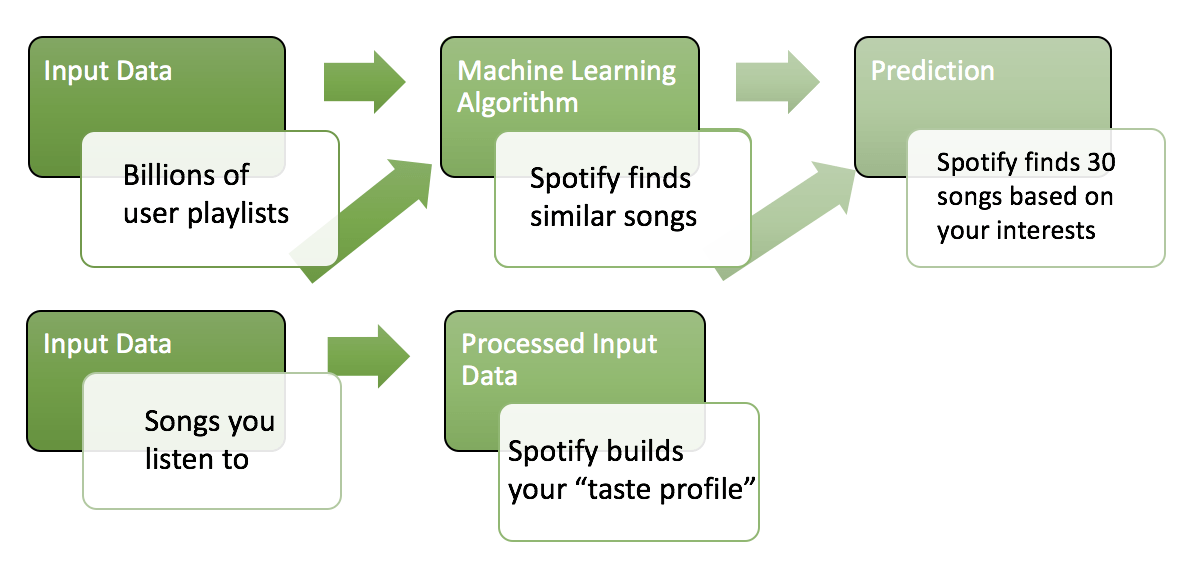
Image Source : “How Spotify know a lot about you using machine learning and AI”
How does Spotify use data science?
Spotify- a
music-streaming app important and used by billions of users daily. The app is
successful in the music industry and is the largest on-demand music service
worldwide. Contemporary technology like Big Data plays a wonderful role in
building Spotify the important music-streaming app.

Image Source:
“Data Science Case Studies – Why is Data Science
regarded as a revolution?”
Currently, Spotify's
net value is more than $25 billion. It has a massive impression on the music
industry by using data in the greatest dynamic ways. Spotify produces a
playlist mechanically according to the user choice; deliver a special touch- it
all can be imaginable using Big Data Analytics. The company struggles to be
completely data-driven and allow users to sort judgements based on data. By
assembling and examining wide amounts of listener data, Spotify can identify
growing user trends in real-time and can rapidly generate new features or
facilities to gain on them. Hence, Big Data is important to raise and enlarge
the development of the company.
How Spotify gather the data?
To accumulate data,
Spotify makes use of some of languages and tools like Java, Hive Hive, Apache
Kafka, and several others. Those are for the principle purpose, for the precise
result. Spotify accepts Big Data and Big Data Analytics. The Spotify app User
involvement is an unimportant floor of Machine Learning and seems to be
critical for the cellular app. The data is specially used for 3 critical
reasons- Playlists, facts, and private history. By amassing most of these data,
it helps Spotify to understand customer behaviour. It will offer them with the
association and information of the music. Through this, they are able to create
a recommendation for the users.
What does Spotify know about you?
If you have been joined Spotify account along
with your Facebook, well then, it is safe to mention that the corporate might
understand additional regarding you than you will be proud of. This realizes
your gender, age, comforts, occupation, and additional (not to say your
affinity for Meatloaf’s Bat out of Hell).For people who have signed up for
Spotify while not losing abundant personal data, the corporate will solely
produce assumptions regarding you supporting your listening habits and place.
Additionally to music recommendations, for non-premium users, this could end in
an additional changed ad expertise between bespoke music recommendations.
How Spotify uses Big Data for Providing Personalized Content
If you already use the
Spotify app, you already understand what “Discover Weekly'' is. If you don’t,
here’s what you wish to understand. With all the info of users that Spotify
has, the platform uses it to develop content distinctive for every user.
computer science and machine learning algorithms facilitate in giving this
personalised expertise.
Spotify launched the
“Discover” feature in 2012 that primarily created a list of the user’s favourite
artists. However, this feature is becoming matured over time with recommending
additional songs of an identical genre, when the list completed. That means, a
user will not go looking for additional
songs of an identical genre once all the songs on the list were complete. it
had been served by Spotify mechanically, victimizing huge knowledge and
computer science.

Discover Weekly Data Flow (“Spotify Recommendation Platform”)
Currently, the showstopper of Spotify is its “Discover Weekly” feature that gives a customized list each week aligned to the user’s style that features songs that they need not detected before. The platform intends to relinquish listeners one thing unaccustomed to getting pleasure from. Machine learning algorithms square measure accustomed to verify that songs are likable by the user.
Spotify’s AI System
Spotify’s algorithm is an AI system known as BaRT (Bandits for Recommendations as Treatments). The job of this AI system is to keep listeners listening. The AI system does this by playing and suggesting songs it knows the user is familiar with, while dropping in some fresh tracks it thinks they might like, but most importantly, haven’t heard before.
BART does the work of recommendation by using three main functions:
1. Natural Language Processing:
The AI system analyses the language, lyrics and content of song.
2. Raw Audio Analysation:
It detects the mood or vibe of a songs audio and decides whether its upbeat, chill, heavy, minimal, instrumental etc…
3. Collaborative Filtering:
It compares new songs to a listeners current habits to decide what will suit their tastes.
The functions of the BaRT are supported by huge amount of the data. But there are four main types of data collected by the app which plays important role in decision making of BaRT:
1. Listening history (mood, style, genre)
2. Skip rate (less skips = more recommendations)
3. Listening time (getting past 30 seconds is the key)
4. Playlist placements (personal, third-party & editorial playlists)
We hope that’s provided some insight into the all-powerful algorithm BaRT and the data science behind the spotify!
Blog By:
Mita Dhaygude Roll No. 75
Prathamesh Jugulkar Roll No. 90
Pradnya Kesarkar Roll No. 93
Disha Kurkure Roll No. 95
Sumit Patil Roll No. 100
SY MECHANICAL C
Vishwakarma Institute of Technology, Pune


Clean and precise information, fantastic work 🙌
ReplyDeleteInformative👍
ReplyDelete👍👍
ReplyDeleteNice
ReplyDeleteeveryone must read
Nice content 👍👍👍
ReplyDeletecontent 👍
ReplyDeleteVery informative.....well organized
ReplyDeleteOhh!! So that's how it works... Good work!! Informative article.🙌
ReplyDeleteInformative content...
ReplyDeleteVery informative content 😊👍👍
ReplyDeleteThis comment has been removed by the author.
ReplyDeleteYou guys really did the good job. Today i came to knew about the data science behind the spotify. Everytime i used think about how they know my fav playlist.
ReplyDeleteIt was really a fantastic information & keep it up !!!
Thank You sir.
DeleteNice blog 🙌.... Much helpful to understand the role of data science in applications 👏👏
ReplyDeleteGreat information 👍👍👍
ReplyDeleteGreat job guys🙌 I wasn't interested in Data science and stuff like this, but this blog made me curious about that. Great Blog 👍
ReplyDeleteGreat job guys🙌 mentioned every aspect👍👍
ReplyDelete